Genetic Engineering
A guide for kids by Tiki the Penguin
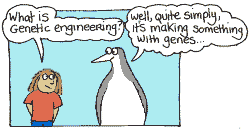
Genetic engineering (GE for short) is about scientists altering the ‘recipes’ for making life — the genes which you find in all living things. Doing this is very clever and seems to be very useful. Back in the 1990s, many ‘Greens’ campaigned against genetic engineering and still do. They predicted disaster but that hasn’t happened. Nobody has died from eating genetically modified (GM) food. They were also worried about the private GE companies’ ownership of the recipes — genes — for making these new life forms. So is genetic engineering okay? And what about CRISPR: what is it and why so important? My guide explains the basics but it’s up to you to make up your own mind about GE.

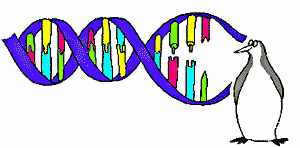
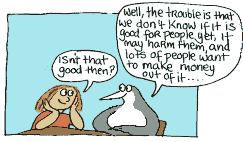
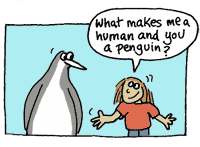
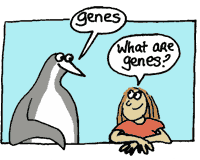
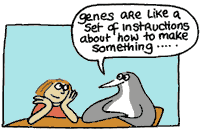

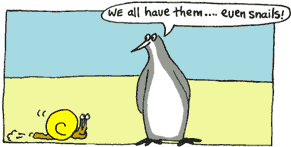

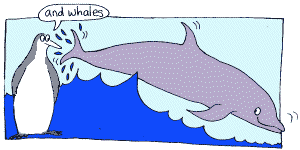
Tiny creatures like snails have them just as big animals like whales do. So do all plants and other living things. Genes are very tiny clumps of information about how to make parts of living bodies … a little like a recipe for a cake or a music track on an old-fashioned cassette tape or CD. But they don’t just exist on their own. They are packaged up in long strings called chromosomes like a whole music album on tape.
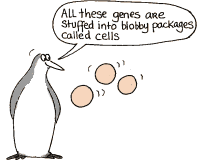
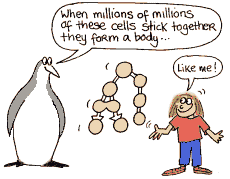 All these genes – that’s all the instructions needed to make you or me – are stuffed in the middle of tiny blobby packets called cells. Cells themselves are very tiny but as millions and millions of them stick together, what we call a body begins to form. That could be a snail, a whale; you or me. (How this ‘sticking together’ happens is very complicated and no-one yet understands it fully.)
When you grow, some of your millions of cells split into pairs of identical new ones. Start with one million and, whooo! – you’ve got two million – twice as big! Now this is the clever bit: all the gene instructions get copied exactly just before the cells split. This is like copying your music album onto another blank CD to give to your friend. So every cell of every body of every living thing on the planet always has this gene body-building information – the genetic code – inside it.
 You may be too young to remember when music was recorded onto magnetic tape on a spool in a tape recorder. The tape was very thin but very long – like DNA in chromosomes – and (like DNA) recorded information, usually music.
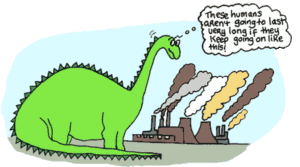 Our home planet is very old. Do you know how old? Well it’s four thousand six hundred million years old. That’s 4,600,000,000 years! And simple life has been around for most of that period — at least 3,500,000 years. That’s plenty of time to try out a system for making new life to replace old, and this works just about perfectly. What’s more, very simple life forms – just single cells – long ago began to join together to make more complicated bodies with thousands or millions of cells. All these new types of life were natural experiments to see what worked and what didn’t. Many didn’t work and died out – they became extinct. Some worked for hundreds of millions of years like the dinosaurs, but still ended up extinct. Humans have been around for just a few hundred thousand years at the most, and have only begun to mess up our planet in the last hundred or so.
 Did you know penguins have been around for over 40 million years and haven’t messed anything up?
 The simplest organisms are
  Some (simple plants) had developed a way to harness the sun’s energy to make sugars which they could then store to use later. And so on. At some early stage, creatures with backbones appeared (the chordates), then clever ones with brains… and the rest you know (unless you left your brain behind).
 Humans first appeared on the planet around 195,000 years ago. At that time, several different human races lived side by side including Neanderthal man (named from where the first skeleton was found in 1856 in the Neander valley in Germany). Neanderthal people died out about 30,000 years ago. No-one knows why… but the first definite modern humans – eleven skeletons found in a cave near Nazareth in Israel – were living just 26,000 years ago. That may seem a long time to you but to a humble little shell (called Lingula) whose descendants have lived quietly and virtually unchanged since the Cambrian Era over 500 million years ago, it must seem like a… like a… well, a very short time indeed! Even to us penguins – and we’ve only been around for about 42 million years – you people are real upstarts, taking over the whole planet like you have in just a couple of centuries.
 The nineteenth century naturalist Charles Darwin was the first to realise that all life is governed by this rule. He found that creatures did indeed adapt though he didn’t know how because, in his time, people didn’t know about genes. It turns out that genes can change. They don’t always make perfect copies when a cell divides. Sometimes a mistake is made. This is called a mutation. Most mistakes are disasters – the organism dies. Some are useful and give the creature an advantage which allows it to have babies which are more likely to be successful. But this process is entirely accidental. This slow business of trying new body shapes and styles, some of which work and some of which don’t, has been going on for as long as life. Perhaps you know about it. It’s called evolution – the survival of the fittest.
Copycat
How does the DNA copy itself? Because it’s made of two corkscrews – called a double helix – hooked together, it can unwind. As it does this, it attracts the right new bits to join the hooks which run down its middle – a bit like the legs on a millipede. And so one strand rebuilds a new mirror-image of itself, just as its mirror-image partner is doing nearby. So one DNA molecule becomes two perfect copies. Clever stuff, eh?
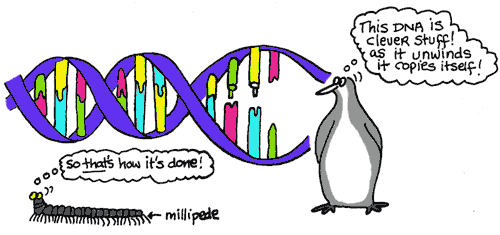 How the DNA itself then organises all the stuff inside a cell to make whatever it needs – like proteins – is complicated. Scientists still don’t understand all the things that have to happen to make what starts as just one cell into a human being or a whale. It’s taken billions of years for nature to develop all this wonderfully clever yet tiny machinery to build bodies. So it’s not surprising that scientists don’t understand everything yet… which makes the next bit rather worrying.
Welcome to gene tinkering
Genes are long bits of DNA which code the instructions to build bodies in certain ways. Scientists know a lot about how genes work. They know how to ‘snip’ genes out of one place and ‘stick’ them into another. This is the hi-tech world of genetic engineering. We’ll look at this in a moment. But first, let’s ask a question or two. Why do it? What’s the point of tinkering with genes – genetic engineering?

Evolution on fast forward
People are impatient. They want to move fast, not just in cars, planes and spaceships. They want to make new types of life which will do new things. The best example is plants for food. About 10,000 years ago, people found a new way to make sure they got enough food: they invented agriculture – farming. The first farmers simply collected seeds of food plants people liked to eat and sowed them in the ground. Each harvest, they gathered in their seed crops and selected the best and fattest seeds to sow in the ground next year. All organisms — plants, penguins or people – have in their genes a certain amount of variation, so gradually this year-by-year selection of the best quality seeds meant that the crops gave better yields of more food which tasted nicer.
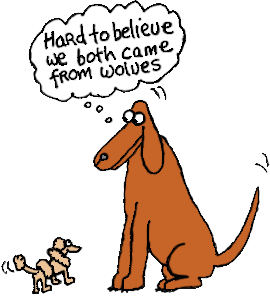 This is called breeding. And believe it or not, all dogs from huge St Bernards to tiny Chihuahuas have been selectively bred by humans from one type of wild dog – probably a wolf. Big dog, little dogA St Bernard and a Chihuahua are the same species even though a St Bernard could gobble up a Chihuahua in one gulp. Being the same species means you can breed with any other member of your species. So you, a human, can breed — or mate — with any other human of the opposite sex to make a baby.
But breeding is rather slow. Scientists have discovered that they can speed things up greatly by using the new science of genetic engineering, part of what is called biotechnology — using life to make things.
‘Engineering’ is a fancy word for building something. So genetic engineering (often just called GE) is building something with genes. Clever scientists have learned to spot which gene does what in making a new organism. They’ve found out that simple organisms like bacteria or viruses often have genes which are useful because they can be snipped out and put — spliced — into plant genes. Doing this could give the plant special new abilities like resisting disease. But this can be rather like grabbing a large scorpion so it can’t nip you with its claws. You know it’s safe to handle since its claws can’t reach you but — ow! — it’s got a sting in its tail you didn’t know about. There may be a ‘sting in the tail’ which comes from splicing strange genes into other organisms — from viruses to plants, for example. No-one can be quite certain what will happen. It is unpredictable.
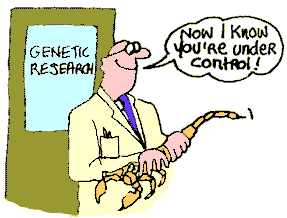
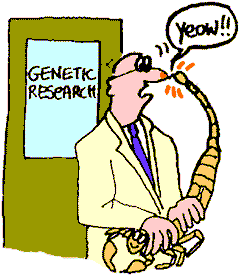 Genes can do unexpected and unintended things and nobody can ever be quite sure what. So it is wise to be very careful.
What can genetic engineering do?
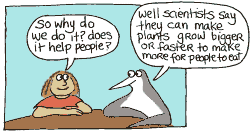
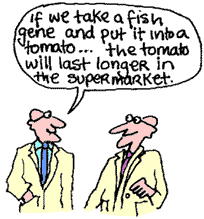
Genetically modified organism, GMOs, (which are mostly plants) are mostly transgenic which means they contain genes pinched from something else like bacteria, viruses, other plants or even animals. By snipping a gene which does something useful from one organism and splicing it into another, say a crop plant, scientists can get the plant to grow bigger or faster or make more for people to eat. Or the plant could be made to be more nutritious with more protein or minerals or vitamins. Some crop plants can be made to grow in salty water or very little water — good for very dry countries. Others could be engineered to resist disease which could protect kids against nasty illnesses like polio or measles.
 And there’s more! Plants have been engineered which use up nitrogen fertilisers more effectively. This not only means that farmers need less expensive fertiliser but also helps slow climate change. Why? Because nitrogen fertilisers produce a lot of nitrous oxide gas which is 300 times more damaging than carbon dioxide as a greenhouse gas. Around 6 percent of warming is due to this gas.
Some plants — like peas and beans — can ‘fix’ the nitrogen they need directly from the air. If all plants could do that, there’d be no need for nitrogen fertilisers at all, so no nitrous oxide pollution.

Energy boost for plants
Most plants, including most food plants, use a process called C3 photosynthesis to get their energy from the sun. But some plants have evolved a better way to do this called photosynthesis. In the future, it may be possible to engineer C3 food plants so that they can use the C4 process too.
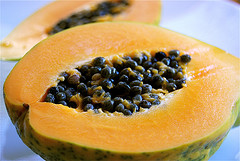 Papayas are delicious tropical fruit but in Hawaii, they were being destroyed by a virus. In 1998, a
  Tough potatoes: Scientists have engineered a type of potato which stops fungal
  Rich golden rice: Many poor people can afford to eat little but ordinary rice which lacks key nutrients like vitamin A. A new type of Penguins have no use for money but I understand why people need it since few people can find their own food any more. And I don’t see anything wrong with making money either… unless making it means damage or death to other people and wildlife.
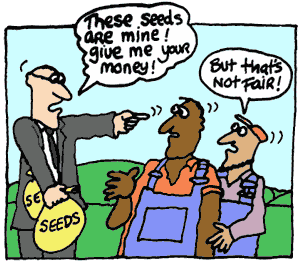 Most companies like to make lots of money and they like to make it fast. This is what companies are for but some don’t care much who or what gets trampled on in the process. The GE companies would really like to have everyone everywhere eating food made from their genetically modified plants. These seeds are mine!Then they’d make huge amounts of money because they own the technology needed to produce the seeds. Once they have changed plants by GE, companies can patent them. This means that any farmer who wants to sow that seed must pay money to the company which owns the patent. It means that the farmer has to buy new seeds every year. She can’t save her (many small farmers are women) own seeds any more as farmers have done since the start of farming. The company, not the farmer, then has control over who grows what food. Many poor farmers won’t be able to afford to buy the seed. Patents on living things has also linked in with a new sort of piracy: biopiracy.
Open Source — the opposite of patentsThe biotech companies want to control genetic technologies because they can make big money from charging for their use — if they own the patents. But, as in the world of computer programs, more and more genetic information is becoming freely available for anyone to use. That’s because much of the science is done by government institutes (especially in countries like Africa, China and India) funded by public money or big charitable foundations in the rich world. The aim is to increase food production by making useful GM seeds available to poor farmers.
But GE is a potentially risky business. How safe will it be if most people end up eating GE food most of the time? What effect will growing all these plants with funny genes have on other plants or animals over time? Maybe nothing will happen – or nothing much. Nobody knows for sure but… fingers crossed!… so far, so good. People have been eating GM foods since the early 1990s and there have been no calamities.
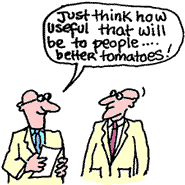
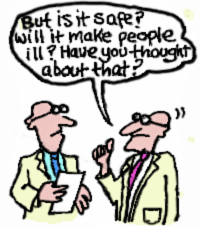
 Humans have a very strange attitude to risk. Probably the most dangerous thing most people do is travel. Loads of people die in road traffic accidents. But they still travel – more and more – and by doing so, they are probably taking the greatest risk of all: messing with our planet’s climate system (see my guide on
 Most of the GE foods grown so far have been for companies to make money and gain control of the supply of seeds. They are not nutritionally better for people and expensive for farmers to buy. The bottom line is that people who think GE foods are really needed must have much better reasons than just making lots of money. They do, of course, and some of those reasons are quite sensible. But will GE crops ‘feed the world’? Private companies have one overriding aim: to make money for the people who own them. Feeding the world is not something they would be interested in doing… unless, of course, the hungry people could pay for the food.
  But hungry people are almost always hungry not because of lack of food, but because they have no money to buy it and no land to grow their own. Perhaps the companies will change and become really kind and generous and give away food to starving people in the future. I hope so. What do you think? Happily, there are other moves afoot which could mean useful GE becoming more freely available to poor farmers in developing countries.
 The honest answer is that nobody knows for sure. Yet GE foods are probably safe enough from a health viewpoint because Americans have been eating them for nearly 20 years and no epidemic has happened. But absence of evidence is not evidence of absence of
  Why? Because they knew they would lose money! And they were right: people and governments have begun to sue them for the damage they caused. You don’t die if you smoke one cigarette – but if people smoke thousands of cigarettes every year (as smokers do) for many years, every one in two will die at a much younger age than they should.
It’s the same stuff!
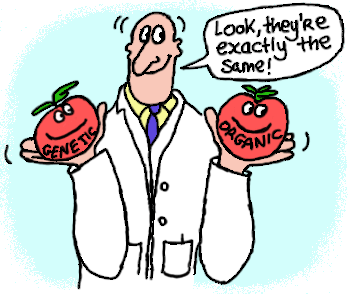 Or is it? The big seed companies claim that their GM seeds and foods are ‘substantially equivalent‘ – meaning more or less the same as ordinary seeds. A soy bean seed or tomato looks the same whether it’s genetically modified or it isn’t. Same or different?They taste the same. They smell the same. So they are the same (almost), say the companies. So there’s no need to test them. Critics say this is wrong. If a plant’s genes have been altered by GE, the plant then makes or does something different. So it is different, and it may have effects that no-one can know about.
These were genuine worries back in the early days of genetic engineering. GE foods were beginning to be eaten by people (and farm animals) in America and many other parts of the world by the early 1990s. But people in Europe protested in a big way, so big that European governments were forced to ban all GE foods and crops. Protesters had several good reasons for taking action. One main objection was that nobody wanted to be a guinea pig. People didn’t want to eat food that hadn’t been properly tested and wasn’t labelled. They mostly still don’t and big protests regularly take place.
So the great world ‘experiment’ to discover whether these new foods were safe, as the companies that made them claimed, went ahead without Europe. Nothing has gone wrong so far, so it looks like GE foods are not the nightmare ‘Frankenfoods’ which many protesters called them. From a food safety viewpoint, they seem to be okay.
 One of most important GE crops is soybeans”I don’t eat those. Yuk!” you probably think. But you’d be surprised because you find them – or stuff made from them – in most foods from bread to hamburgers. Maize or corn is the other most important crop. And there are many more, mostly not important yet. But what’s different about these GE crops if they don’t taste different or look different? For the moment, there are two main differences: many of these GMOs are made to be resistant to the weedkilling chemicals. That means farmers can spray their GE crops with weedkillers (herbicides) which will kill every single plant except the crop. The other GMO crops have been engineered to make a poison which kills insect pests. These sound like a good idea — but are they?
Problems with weedkiller-safe crops
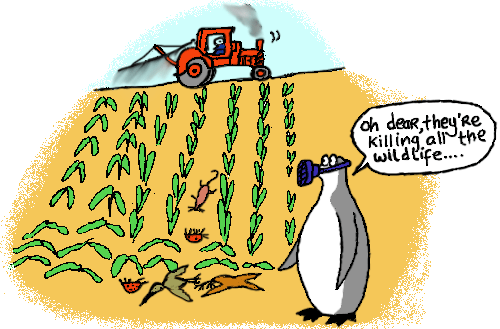 Farmers like tidy fields and weeds compete with crop plants meaning that the farmer gets less crop and less money.Tractor spraying weedkiller So making sure no weeds grow by spraying herbicide seems to make sense … but not for the other creatures and plants that live in the area. By killing everything but his crop, the farmer is making the landscape into a desert for other life. No birds will be there because there are no weed seeds or insects to eat. There will be no flowers. Just miles of identical GE plants.
 There are dozens of genetically engineered crops approved for sale in many parts of the world. Most are foods like soybeans, corn (maize), squash, sugar beet, papayas, tomatoes and potatoes. These are now part of the food supply for most people and are the so-called first generation. They have benefited the companies that produce them and the farmers who grow them but had no particular benefit for the public who are eating them. Also
 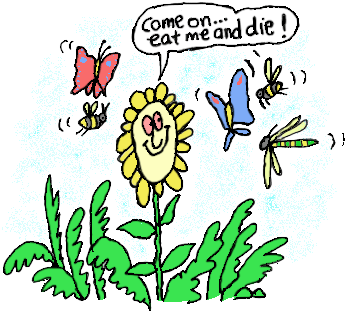 Insects are very successful creatures. They are very adaptable and, Ha ha! Eat me – I’m a killer!because of their own variable genes and because they breed so fast, can quickly overcome chemical poisons used by humans. Every time a new poison — pesticide — is made, within a few years, pesky insects become immune to it. The same is already happening with the new transgenic plants which make their own insect poisons. Unfortunately, these same poisons are very important in organic farming as a weapon of last resort. Organic farmers use it only occasionally and it’s very effective because the pests have no chance to get used to it. Some transgenic crops make this poison — called Bt toxin — all the time in every part of the plant: roots, stems and leaves. So insects are developing resistance to the poison which will soon make Bt useless.
But what about the people or animals which eat these plants? Fortunately, Bt toxin is poisonous only to insects and appears to have no effect on other animals. But not everybody agrees that this is the case. Who and what do you believe?
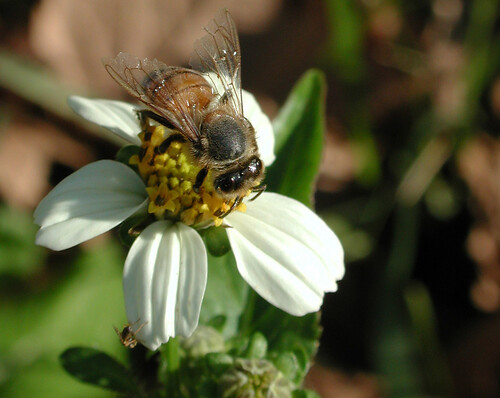
 What happens when GE plants grow where they’re not supposed to? Or when their genes get scattered around by accident? When plants flower, they do it for one reason only: to make new plants. The flowers attract bees which collect pollen from the male part of the flower. The bees visit hundreds of similar flowers, some of which may be miles away, and leave some pollen from their earlier visits on the female parts of later flowers. The male pollen connects with the female part of the flower and combines its genes with the female’s genes to make a new seed. This is called ‘pollination’ or ‘fertilisation’, long words for plant sex. Some other plants (like maize, a member of the family of grasses) use the wind rather than insects to carry their pollen around. This pollen can travel a very long way.
 flowersIf pollen from a GM plant happens to land on a plant of the same species which has not been genetically modified, it fertilises the unmodified plant just the same. But the GM genes will become part of the new seed. When the seed grows into a new plant, it may grow up to be just like its engineered parent. It will be contaminated. This is one of the main reasons many people object to GE plants because there is no way to stop this contamination – called gene flow – if the GMOs grow in open fields on a large scale (as they do).
 Wherever GM crops have been grown, some genes ‘flow’ into other non-GM crops or wild relatives. Until recently, some people claimed that this gene flow was of little importance because pollen didn’t travel far – no more than a few hundred metres at most. But pollen from genetically modified maize may have travelled on the wind to remote parts of Mexico. GM maize, ordinary maize and wild maize (corn) are the same
 Genetic engineering is just one powerful tool in the kit of tools which farmers and food producers can use to feed the world. It could also help wipe out some diseases.
The Catholic church — which has over 1 billion followers — has had a change of heart over genetic engineering. They formerly condemned it as “playing God” but in late 2010, Vatican scientists claimed that scientists have both the right and a moral duty to be “stewards of God” by genetically modifying crops to help the world’s poor.Source
But it does need to be very carefully watched and regulated — something the companies don’t much like. Wisely and cautiously used, GE has a big role to play. In their scramble for profits, will the big companies bring about the world’s end? The GE companies are driven by their need to make big profits for their shareholders. They have been very secretive about what they are doing and, of course, protect everything they do by patenting. If they own the seeds and techniques for making them, they call the shots. It is no coincidence that the makers of herbicide-tolerant crop seeds are also the manufacturers of the herbicides. They cleverly make sure that farmers who buy their seed must also use their brand of herbicide to kill all the weeds. The companies are, first and foremost and like all companies, out to make money, not save the planet or feed the poor. They can help, of course, and some do — but that’s not their main aim. 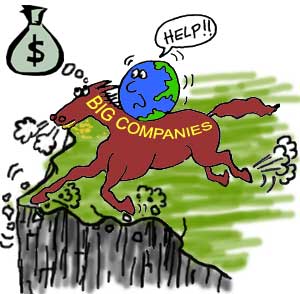 Much GE is now done in universities and institutes and is increasingly open source. This means that farmers — even poor farmers — can get involved in creating new crops by telling scientists what traits (like drought resistance, salt tolerance, the ability to withstand flooding and so on) in crop plants they actually need. The seeds are sold at low cost or even given to farmers who can then save some of them, if they wish, for the next crop. By engineering special traits into food crops, they could be very useful in organic farming. But the organisations that licence organic growers, are strongly opposed to all forms of GE, despite the fact that some GE plant varieties could be very useful in organic growing systems. Some people believe that organic farming needs to get together with genetic engineers and not miss a wonderful opportunity for big advances in, to take just one example, disease-resistant crops.
The future is CRISPR
Everyone’s talking about CRISPR. This is the latest thing in GE and is a fast and precise technique which is bringing a revolution in biology and medicine. It is a gene-editing tool based on a bacteria’s anti-virus immune system and ‘hijacked’ by a team of scientists led by Jennifer Doudna and Emmanuelle Charpentier back in 2012. This tool includes CRISPR, a protein called Cas9, and hybrid RNA that can be programmed to find, cut, and even replace any gene sequence. CRISPR is easy to use compared to older gene-editing methods, and works for any type of cell. This makes it very powerful and, in the wrong hands, very dangerous. It needs to be carefuly regulated but this could be difficult to organise since it is already being used in several different countries. So keep your eyes on this CRISPR ball!
People who are against GE think it’s unwise to be running GE ‘experiments’ in the open air on a huge scale. But the experiments have been happening for years in the US, Argentina, Brazil, India, Canada, Australia and China and other countries. Only Europe opted out because of mass protests which began in the 1990s. They didn’t wish to be used like guinea pigs for testing new food crops which offered them no obvious benefits. They wanted GM food to be labelled so they could choose whether or not to eat them.
 Only time will tell if GE is perfectly safe or whether it is really as dangerous as many of those who are against it believe.
 In China, millions of small farmers are finding the GM crops have their uses. Chinese scientists have concentrated on making GE rice, the most important food crop in China, which resists major pest insects. They’ve done much the same with wheat, tomatoes and sweet peppers, making them resistant to pests and diseases. Other similarly altered food crops are coming soon. The short-term benefits are obvious. More food, less need for pesticides and many fewer pesticide poisonings. Unfortunately, there’s only likely to be a brief breathing space before the bugs and diseases become used to these GE crops.
 The “Once biotech is freed from the grip of large corporations, it will no longer seem alien or controversial.” Stewart Brand, Whole Earth Discipline reporting renowned physicist Freeman Dyson‘s views.
 In the longer term, it looks like many types of GE could be useful. Quite apart from food, itDNA, the code for life might mean new ways to cure diseases or to prevent them in the first place. But — and this is a very big BUT indeed! — people need to know what’s happening and why. You need to get involved in thinking about whether GE (and other new human technologies) are good or bad… or if bits of them are good and other bits bad and dangerous. You also need to have a choice, to have a say in what is done or not done. You need to have proper labelling on the stuff you eat and drink so you know how it’s made. Governments and companies tend to keep rather quiet about GE. After all, people can’t object to things they don’t know about. Secrecy worries people and as they come to realise just what’s been going on, they want more openness. Don’t you want to be involved in deciding the future of life on our planet? GE could affect natural life in all kinds of ways nobody yet knows. If companies release lots of GMOs and something goes terribly wrong, who pays for the Tired Tiki the eco-warriordamage? Can the damage be repaired? Please think carefully about

what
           kind of a
                 future
                      you really want.
- Ask questions
- Don’t let others do your thinking for you!
- Don’t leave it to the ‘experts’. Become an expert yourself! A good start would be the Royal Society’s Genetically modified (GM) plants: questions and answers (May 2016)
 The poor birds would keel over and die before poisonous or explosive gases built up to danger levels for miners. They were the first ‘pollution sentinels’. The zebra fish, like the canaries, are so sensitive that they show even tiny traces of poisons by glowing – traces which scientists would only be able pick up with the best equipment they have. Another advantage is that the fish are quite similar to mammals (including humans) in the way their bodies process food and poisons. So if you ever catch a glowing zebra fish, don’t eat it or drink the water!
 These days, everyone knows about terrorism. Unfortunately, genetic engineering could easily be used to make organisms that kill people by infecting them with new types of disease. Or they could be used to infect and kill food crops or farm animals. Then people would die of hunger. I find all this really scary as I expect you do. Pretending there isn’t a problem is not the answer.
 Australian scientists recently accidentally created a monster while they were trying to engineer a mouse virus [1]. The idea was not to harm the mice, but prevent them having babies. Not only did it not work. It killed the mice. Not too worrying, you might think; they were only mice. But it would be easy for a laboratory somewhere to secretly engineer a similar virus which infects humans and kills them. This would one way of using GE for making a deadly biowarfare agent. There are many others. Really scary.
 Genetic engineering is a powerful tool. But like all technology , people can choose to use it for good or bad reasons. Used wisely, it could be vital in helping people produce more food without doing so much damage to to the planet’s other life. So far, it has mostly been used to make money for companies and farmers without much thought about anything else.
You will, as you grow up to become an adult, be inheriting this world of clever technologies like genetic engineering. To help make sure it is a better world for you, your friends and family, you have to know what’s going on. You have to know what the scientists, the companies and governments they work for are doing — and why. If you don’t do this, who knows what they might get up to. You have to be always vigilant.
Here’s what you can do:
- Discover as much as you can about GE. Why are some people so against it? Why do others think it’s great? What do you think? Should the companies be better regulated and monitored?
- Find others who feel the same way as you do. There are many groups in many countries all working to wake up other people to the possible risks of GE. You can join and I’ve listed some on my links section. It’s ever more easy to network with Facebook and Twitter!
- Ask questions. Don’t accept answers you don’t think are honest. Question where the information comes from. Is it biased? Be sceptical.
- If you think patenting and ownership of genes is unfair, help campaign for GE to be open source so that everyone can benefit.
- You can send emails or write letters to your local or national government in your country – that would really surprise them.
- Call or write to the GE companies. Tell them what you think and why. Are they open about what they are doing? Some of them might be pleased to know you’re interested in their work. They all have very good websites. See my links section for some of them
- Get your mum or dad to help you (and them) find out more. Do they know about GE? What do they think about it?
- Write to your local newspaper.
- Join your local radio phone-in or ask questions on a TV chat show (if you can).
- Talk about GE to your friends or your teachers at school. Get your teachers to run some kind of science project where you all help each other to find out more.
 I’ve written this guide just because I love all life on Earth and I want you and your friends to think for yourselves and help persuade your human companies and industries do things which are useful, sensible and not damaging to the rest of life. It won’t be easy, but there’s one thing I’m sure of:
You can do it!
Check out my links section to find out more about groups concerned about genetic engineering and who are trying to change its direction for the common good of all. I’ve also added some sites which will tell you GE is a great idea. See what you think.
Good luck kids. It’s your world…!
Did you find my genetic engineering guide useful? If you did, please tell your friends about it. Thank you!
Genetic engineering: My links to other sites
There are loads of places to visit so I’ve just selected a few which I like the best. And please avoid disappointment and don’t send me more links, no matter how useful you think they are. Lots of people do but I simply don’t have time to deal with them. Sorry!
Genetically modified (GM) plants: questions and answers Explore 18 questions about genetically modified (GM) plants. Britain’s Royal Society conducted a poll to find out what people want to know about GM plants, and then drew on a panel of expert, independent scientists to answer your questions. “We hope that these answers explain the science behind GM and help you form your own view,” says the word’s oldest and most respected scientific society. You can also download all this as a PDF.
Genetic Technology Here, BEEP looks at both sides of every aspects of genetic engineering. Great site.
Alliance for Science Excellent up-to-date site

 There are just four chemicals (called bases) Adenine, Thymine, Guanine, Cytosine – A T G C. The code is built up from combinations of those four. A always links to T; G to C. So when the molecule uncoils, as it does to make copies of itself, each base seeks out and links to its new partner (A to T, G to C) – building blocks of life and two new molecules build up where there was just one before. The details of this are very complicated but you’ll get the main idea of how DNA is the genetic code — the genotype — for how to build proteins which are the building blocks of bodies — the phenotype. The DNA also contains instructions for how to assemble everything, how big to make it and where to put it. That’s why my beak and your nose is on our faces – and not somewhere else on our bodies. Nobody yet understands how all this works in detail.
 The rest died out. If most of the world was like the Antarctic, penguins would be the commonest creatures (I wish!) and people, who don’t like the cold, would not exist at all. We penguins are supremely adapted to live successfully in bitterly cold oceans and on ice. If the world suddenly got hot (as is happening as humans cause climate change), penguins would be in serious trouble. Species evolve by random changes whose cause Darwin didn’t know (see
  For example, it could be a plant that resists a particular type of weedkiller or it could be a
  No-one knew about
 What about a crab and a toucan? Well they are definitely not the same species! Pretty obvious really. For a start, crabs have 8 legs and toucans have two. And crabs don’t fly… How many species can you think of? And how many species are there on the planet? Scientists estimate that there are at least 5 million but there are probably many tens of millions more which we still don’t know about, mostly living in the oceans.
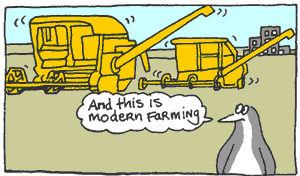 The damage modern industrial farming does is not always obvious because people have short memories. Where there were once forests and prairie with all their complex web of plants and animals, there are now just huge areas of ploughed earth. Enormous machines damage the soils and open it to being
  They scatter artificial fertilisers. The machines themselves pollute the air with smoke and fumes while the poisons and fertilisers soak down into the soil or run off into streams and rivers. This
  Soil erosion is a serious problem which is caused by bad farming practices. The best known example was the 1930s Dust Bowl of the Great Plains of North America.
  The best known biotechnology of all is brewing – you know, making beer and wine and stuff. People use tiny plant-like organisms called yeasts to change sugary water (usually flavoured with something) into alcohol. Plant and animal breeding is another where people choose particular traits — qualities — which an organism has. An example is corn — maize. For centuries, this plant was carefully selected by Mexican farmers to favour one which gave bigger cobs with more and fatter grains of corn on each .glass of beer Today, everyone takes this for granted, not knowing their breakfast cereal or corn crackers are the result of all this careful work done many years ago and made
  But now, science has created new types of biotechnology such as cloning (making identical copies of organisms or cells) and, of course, genetic engineering — the subject of my guide. GE is based on the artificial manipulation and transfer of genetic material from any type of organism to any other type.
 Biopiracy: Pirates were a bloodthirsty lot who stole and killed to make themselves rich. Often, they ended up getting killed themselves. They were outlaws, hunted down whenever possible by naval ships from various countries. The biopirates are a bit different. They don’t kill, they
  This has outraged many people on the receiving end of this legalised theft. The Indian scientist Vandana Shiva claims that the real cause of biopiracy is the left-over colonial idea dating back to Columbus’s ‘discovery’. sailing shipColumbus ‘discovered’ the Americas in 1492 and from that time on, Europeans began to take the land away from the native Americans, the original inhabitants of what are now Latin and North America. (They did the same in Africa and Australia.) The Americas became Europe’s colonies, to be exploited in any way – including killing native people if they objected. It’s this same colonial tunnel vision which permits the piracy of gene resources and knowledge from non-Western cultures to be claimed as ‘invention’. This means this once-free heritage of seeds or knowledge can be protected by patent. This is just legalised stealing. Knowledge now strangled by patents (called in legal language ‘intellectual property rights’ or IPRs) used to be freely shared between everybody who needed to use it. I think your laws are unfairNow, after patenting, people have to buy it to be able to use it legally – including those who had learned it as it was passed down through each generation in their communities. I don’t know what you think about that but I think it’s wrong. Your laws need changing!
 Many insects are pests. They eat many of the food plants farmers grow and, not surprisingly, farmers try many tricks to stop the insects.
 In Britain, a detailed study found some carrots on sale in shops with not twice, not four times, but 25 times the allowed pesticide residue (what’s left after harvest) in them. These
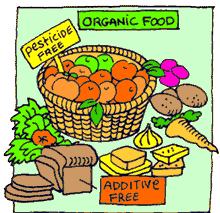 What’s so great about organic food? It looks much the same as ordinary food produced by
 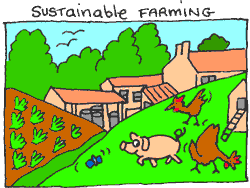 Sustainable farming(= sustainable agriculture) is growing food in a way that means you can continue to do it for ever. It does not depend totally upon cheap energy (fossil fuel) which is now used to power huge machines and for making
 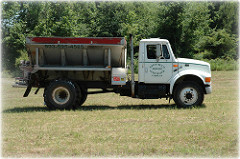 Artificial nitrogen fertilisers are now readily available thanks to the Haber-Bosch process (invented in Germany in the early 20th century). They are made by reacting nitrogen gas (from the atmosphere, most of which is nitrogen) with hydrogen gas to make ammonia compounds which plants need to grow properly. The hydrogen comes from methane which comes from natural gas, a fossil fuel. And the process itself requires high-pressures and temperatures which uses a lot of energy and that, of course, also comes from fossil fuels.
 A few hundred years ago, almost everyone either worked on the land or had direct links to it. Then came the
 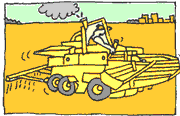 Intensive agriculture is another name people use to describe modern industrial farming. It has been very successful at producing cheap food but there are hidden costs and it depends totally, directly and indirectly, on
  The same is true in Britain where the pressure has been on to make farms bigger and ‘more competitive’. Family farms are going bust which is very sad. Farmers who own their land and work on it every day tend to look after their property in a kindly way, leaving space for other animals to live there with them. Huge farms owned by companies are run, like factories, just to make a profit. Wildlife and caring for the environment are not on the agenda.
 And so it is with your house (or your room in your parents’ house): you care for it because if you don’t, you suffer if it falls down or gets really yukky. If you owned thousands of houses (or rooms) and rented them out to other people, nobody would much care for them.