|
Nuclear
power – Help at hand?
Possibly.
Nuclear power doesn't add much to global warming – but it does
create other types of wastes which are nasty
because they are radioactive.

Building a nuclear power station and mining and making the fuel for it to operate does produce CO 2. These power stations need a lot of concrete - which is made with cement - and making cement produces a lot of CO 2 also.
I've explained about radioactivity in the box below. Scroll down to see it.
Radioactivity
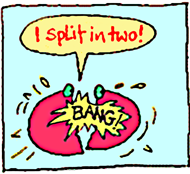
gets made inside nuclear power plants as the fuel – uranium metal – splits
into other elements which give off radiation. So far, no one has worked
out a way to safely dispose of the waste this makes, so at present it's
all stored – huge quantities of it. And if the
power plant goes wrong (Chernobyl) or is damaged by eathquake and tsunami, terrible
disasters can happen.
 Facts
about Radiation Facts
about Radiation
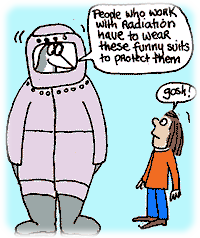
 Radiation
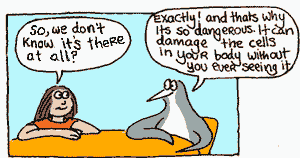
is scary because no one can tell it’s there without special detectors.
Animals like you and me have senses which means we can see, hear,
touch, taste, smell – but we can’t tell if something is radioactive.
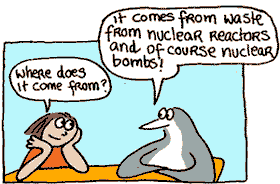
Waste products from making nuclear bombs and from nuclear power
plants are very radioactive indeed. If you happened to fall into
a nuclear reactor, you would die almost instantly. Lower radiation
levels can also make people die – over a matter of days or, by causing
illnesses like cancer, over a period of years. Radiation comes from
new elements (uranium fuel is an element;
so is carbon and so is oxygen) which get made during nuclear reactions.
The radioactive isotopes of these elements, often only exist for a few weeks or years. But
some last for hundreds of thousands of years which is why no one
really knows what to do about getting rid of them. Radioactive isotopes
have what's called a half-life. Radioactive isotopes with short half-lives quickly
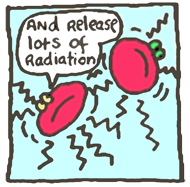
disappear by spewing out streams of tiny particles which travel
very fast. This is radiation and it’s
dangerous to life like you and me. So if you stand near something
radioactive, you’re being hit by trillions of tiny ‘bullets’ all
the time. You can’t feel it but these ‘bullets’ damage the cells
in your body. A lot of damage breaks them and you die. Less damage
messes up their genes and causes cancer and kills you slowly. Like
I said, nasty stuff.
That means it gives off radiation.
What's a half-life?If an isotope of an element – let's choose iodine as an example – has a half-life of 8 days, this means that if you start with a chunk of the iodine-131 isotope which weighs 100 grams, 8 days later, it will weight exactly half what it did: 50 grams. Sixteen days from the start, it will weigh just 25 grams. And so on. So isotopes with short half-lives don't stick around long.
If nuclear power is so dangerous, how might
it help?
Nuclear power stations have been making electric
power for over 50 years. People understand their dangers very well so
the risk of using them is less than it used to be. A scientist or nuclear
engineer would say 'the technology has matured'. Nuclear stations have
several advantages over other ways to make electricity:
 they can run at full power for many months at a time
they can make enormous amounts of power from a small amount of fuel.
Just one
station can provide enough power for a city
One station can typically generate 1 gigawatt of power. One gigawatt is 1,000,000,000 watts; that's one thousand million watts. Of course, 1 watt is a very small amount of energy but it's enough to keep a modern TV on standby
they do
not themselves produce any greenhouse gases and so don't cause climate change. Nor do they pollute the atmosphere with smoke containing sulphur
and nitrogen oxides unlike coal plants, so they don't cause acid rain.
Mining and processing nuclear fuel, building the power station and taking it to bits again at the end of its life does create greenhouse gases. So does mining coal and building power stations to burn it. But it's the burning of the coal which really gives off monstrous amounts of CO 2. 'Burning' nuclear fuel – whatever it is – does not do this.
Acid rain is caused by burning fossil fuels like gasoline and coal. Burning these fuels creates gases called sulphur dioxide and nitrogen oxides. These dissolve in raindrops to form acids: sulphuric and nitric acid.
 It's
certain that many more nuclear plants will
get built because people are used to having
electric power at the flip of a switch all
the time. 'Green' (environmentalist) people
have always been against nuclear power and most
still are. They want a world powered by
renewables like wind and solar energy. The
trouble with that is that renewables aren't always producing power and people today
are totally used to having energy available
whenever they want it. Relying on renewables
would mean you couldn't be sure the lights
would go on when you flipped that switch!
So some Greens now accept that nuclear
power should be part of the mix of power
sources – including renewables – which
could produce a steady, reliable 'background'
of power at all times. There are some who
think that if people are going to go for
nuclear power in a big way, it could all
be made much safer if the reactors could
be built underground. Find
out why. And now there are special
reactors
which can not only generate huge
amounts of power but use up the dangerous
radioactive stuff which is produced in
older reactor types, so they need hardly
any fuel.
But mostly, these are still on the drawing board – only one or two have ever been built. It's
certain that many more nuclear plants will
get built because people are used to having
electric power at the flip of a switch all
the time. 'Green' (environmentalist) people
have always been against nuclear power and most
still are. They want a world powered by
renewables like wind and solar energy. The
trouble with that is that renewables aren't always producing power and people today
are totally used to having energy available
whenever they want it. Relying on renewables
would mean you couldn't be sure the lights
would go on when you flipped that switch!
So some Greens now accept that nuclear
power should be part of the mix of power
sources – including renewables – which
could produce a steady, reliable 'background'
of power at all times. There are some who
think that if people are going to go for
nuclear power in a big way, it could all
be made much safer if the reactors could
be built underground. Find
out why. And now there are special
reactors
which can not only generate huge
amounts of power but use up the dangerous
radioactive stuff which is produced in
older reactor types, so they need hardly
any fuel.
But mostly, these are still on the drawing board – only one or two have ever been built.
This is for two sensible reasons. One is that nuclear power has always been strongly linked to nuclear weapons. The plutonium needed to make a bomb is made in nuclear reactors. And most reactors need 'enriched' uranium to work properly. Enrichment is a technology which can be used to make nuclear fuel and also atomic bombs. The second reason is that there is – so far – no truly safe way to deal with nuclear waste. (I explain more about this lower down the page.)
Most renewable energy, other than hydroelectric power, comes from either wind turbines or solar panels. If the wind doesn't blow or it's night time, there's no power.
 Getting
rid of waste Getting
rid of waste
So
why not go nuclear? Why not build loads
of new reactors and make green electricity?
There are still problems with
nuclear which can't be easily fixed. The
biggest of these is the radioactive
waste they make while they're operating.
There are ways to deal with this, some short term and some longer term though there is no simple solution
to the big issue: nuclear waste is nasty stuff. But there are
good reasons to hope that the waste problem
can be solved using IFRs.
Using wasteWaste can be turned back into useful fuel in a very tricky operation called 'reprocessing'. In this, technicians dissolve the highly radioactive fuel rods in acid and, using clever chemistry, separate out the parts which can be re-used as fuel: unused uranium and plutonium. This is called 'mixed oxide fuel' (MOX for short) and can be 'burned' in reactors. What remains is a hot very radioactive acid liquid which has to be stored in special tanks. This is probably the nastiest stuff humans have ever made. What do you do with it? One solution is to make it into glass blocks which are much safer to store than acid liquid. Another solution is not to reprocess in the first place and leave the fuel as solid radioactive rods. Some countries choose to reprocess; others choose not to.
Permanent storageSooner or later, all these stores of hot radioactive stuff have to be made safe. The best answer anyone has come up with so far is to make the liquid wastes into solids – a process called 'vitrification' (which means 'making into glass'). Then the hot solids get buried or stored deep underground in special 'repositories'. The idea is to make sure this stuff is kept out of harm's way for many thousands of years during which time the radioactivity will die away to almost nothing. The difficulty is finding good places to do this.
The most dangerous waste has to be kept away from living things for thousands of years before the radioactivity dies down.
Nuclear future?
The
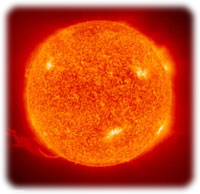
biggest fusion reactor of all: our sun
 |
There are better and safer methods of using
nuclear energy. Some are just around the corner and some further away.
One of the brightest stars is nuclear fusion. This is making energy in the same way that the sun
makes it. Instead of splitting atoms to make heat, hydrogen atoms
fuse into helium atoms at unbelievably high temperatures such as you find
in the middle of the sun: that's around 50 million degrees. This fusion
of atoms gives off really massive amounts of heat and light which is why our
sun is hot and bright. Scientists believe that they can mimic the sun
in fusion reactors here on Earth but using the technology as an energy
source is still many years in the future.
Nuclear: what's coming?Most reactors in use today rely on complex emergency cooling systems and people to control the reactor. New designs would shut down and be cooled automatically if anything went wrong. Other types of reactor – called fast breeder reactors – can actually make more fuel than they burn and could be used to literally 'burn up' the very nuclear wastes which are so dangerous. Yet others could use thorium (Thorium-232) to make its own fuel – another isotope of uranium (Uranium-233) – in a cycle which results in much less radioactive waste
That's a sort of joke really. All stars are powered by fusion reactions and are very bright indeed!
Let's now look at the
energy alternatives, called renewables, so you can decide for yourself
which energy source is best.
|